


In this post, I will talk about a very important element for modern technologies. The use of lithium allowed the improvement of batteries. The best batteries have lithium.
Properties
It is the lightest of metals, with a density of 0.535 g/cm^3. It is a very reactive metal with water, for being monovalent (the atom has only one electron to share).
The chemical reaction when it reacts with water.
2Li+2H_{2}O\rightarrow 2LiOH + H_{2}
This element is very soft and can be easily cut with a knife. It is a good electrical conductor. When the lithium salt is burned, the flame has a red color.

When the combustion is more violent, the flame is white and bright.

Biggest reserves
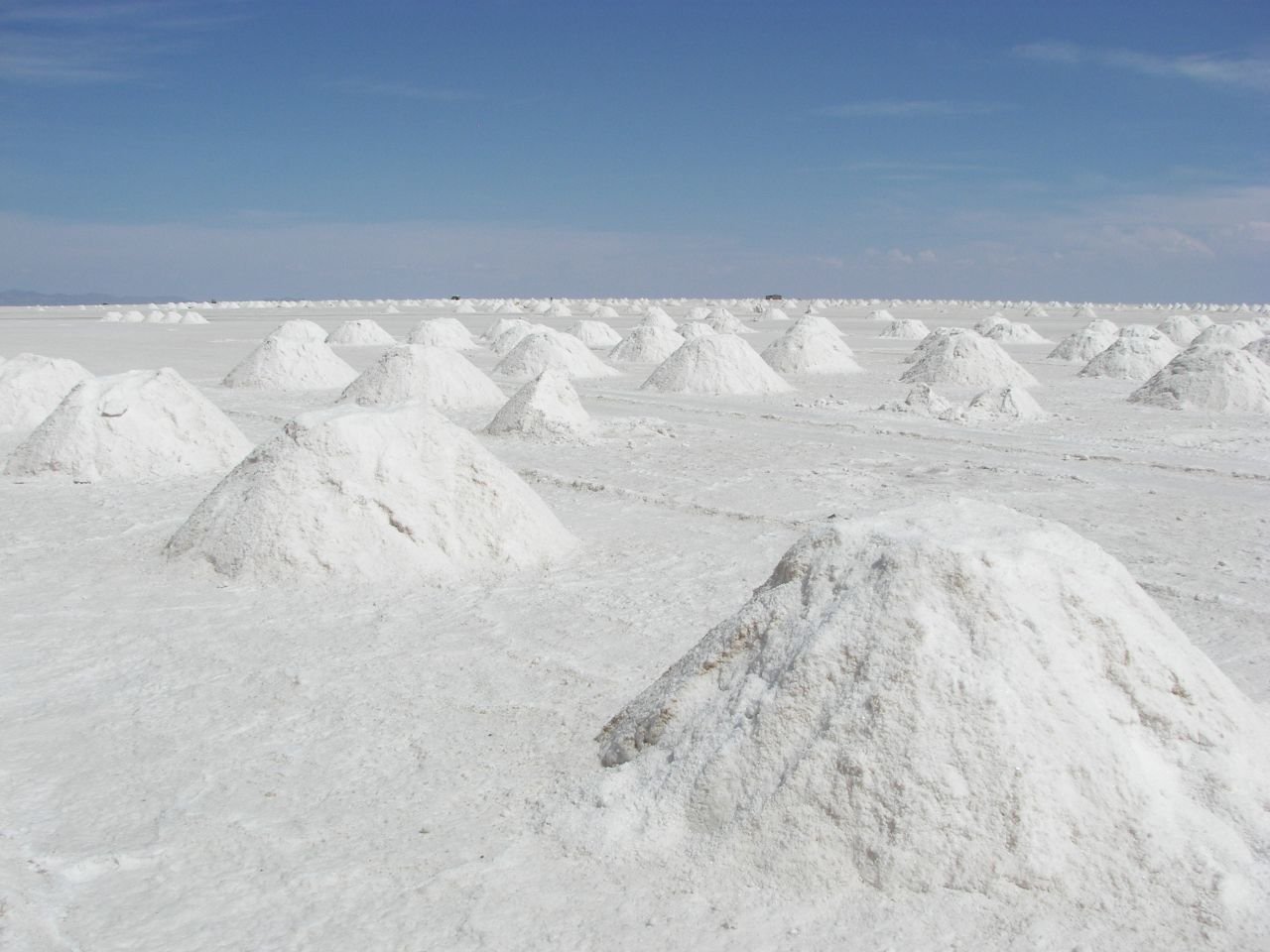
The biggest reserves stay in Chile and Bolivia. There are also considerable reserves in China, Australia, Brazil, Portugal, the USA, Canada, and Zimbabwe.

Extraction
In nature, it is present in the form of petalite (LiAlSi_{4}O_{10}).

Other minerals are the lepidolite (KLi_{2}Al(Al,Si)_{3}O_{10}(F,OH)_{2}).
 And the spodumene (LiAl(Si_{2}O_{6})).

This element can also be extracted from brines of some salted water and left in the Sun to evaporate. The ore is calcined to be mixed with sulfuric acid. It is created the lithium sulfate, which is purified and separated to be treated with sodium carbonate, creating the lithium carbonate (Li_{2}CO_{3}). The lithium carbonate has some applications, for that part of it goes to commerce. The other part is treated with calcium hydroxide to produce lithium hydroxide (LiOH), which also has its applications. Here is the production process of the carbonate and hydroxide of this metal.

To produce the metallic lithium, mix hydrochloric acid with lithium carbonate to produce lithium chloride. And an electrolysis in the chloride produces the metal. Below, we have reactions of oxidation and reduction, respectively.
2Cl - 2e^-\rightarrow Cl_{2}
Li^+ + e^-\rightarrow Li

Environmental impact
Extracting ores from mines causes the typical environmental impact from mining. However the most of it is extracted from brines, which don’t need much water, and it is made in places where there is very little wildlife, therefore the environmental impact is much lower.
Some applications
In addition to being used as an anode in the best batteries, can be used in the metallic alloys of aluminum, cadmium, copper, and manganese in the aeronautic industry. The small addition of lithium carbonate can make glass and ceramics stronger. The lithium hydroxide is used in submarines, spaceships, and space stations to extract the carbon dioxide from the crew and debug the air. This graphic shows other applications.


Excellent site very cool! another excellent subject i loved the article.
Your website is amazing congratulations, visit mine too:
https://strelato.com
.
Thank you. I already visited your website.