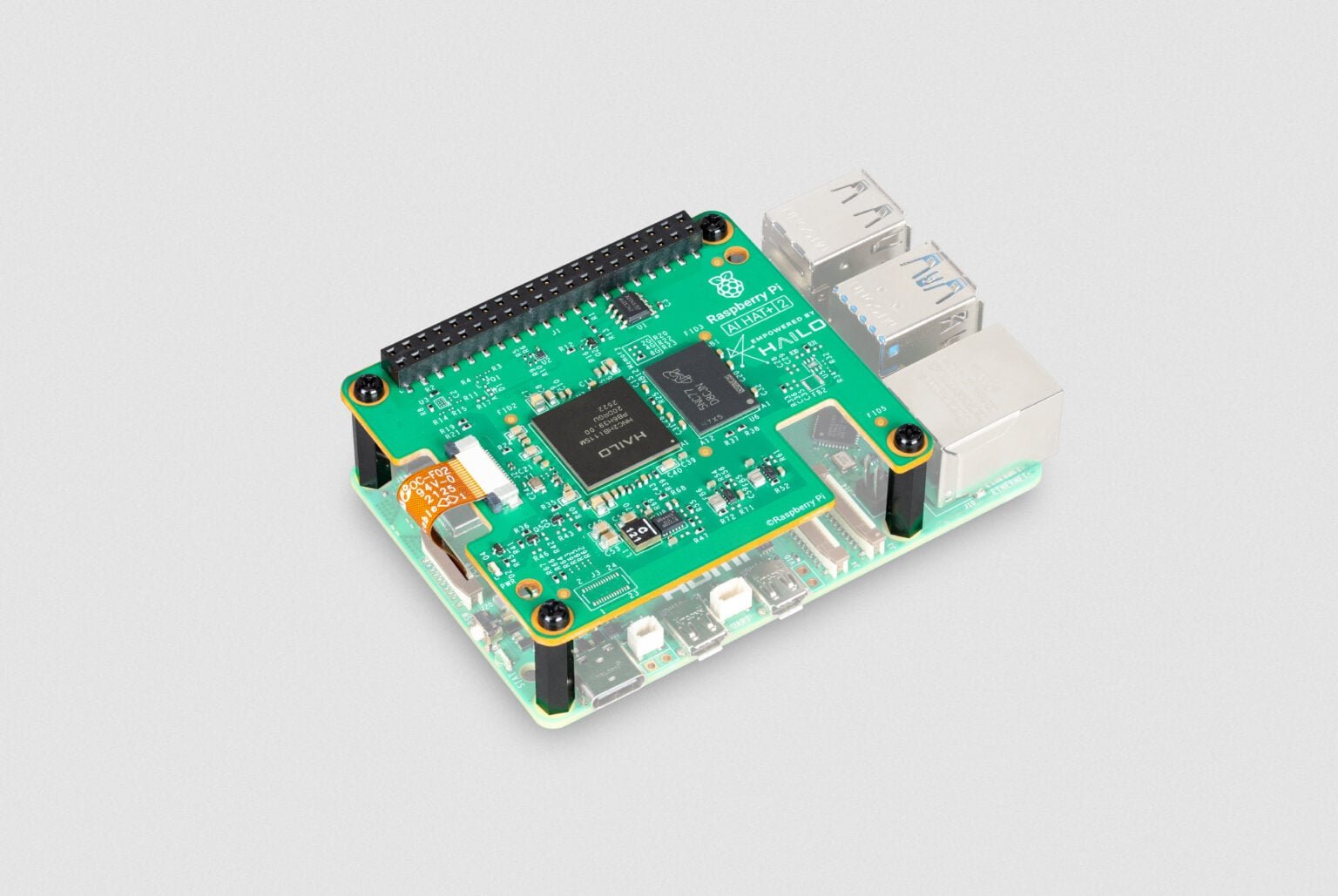
The Raspberry Pi AI HAT+ 2 was released, which allows putting a generative AI in a Raspberry Pi 5.
To know what generative AI is, click on the following link.
Introduction to generative AIClick here
Source: Raspberry Pi
A little over a year ago, we introduced the Raspberry Pi AI HAT+, an add-on board for Raspberry Pi 5 featuring the Hailo-8 (26-TOPS variant) and Hailo-8L (13-TOPS variant) neural network accelerators. With all AI processing happening directly on the device, the AI HAT+ delivered true edge AI capabilities to our users, giving them data privacy and security while eliminating the need to subscribe to expensive cloud-based AI services.
While the AI HAT+ provides best-in-class acceleration for vision-based neural network models, including object detection, pose estimation, and scene segmentation, it lacks the capability to run the increasingly popular generative AI (GenAI) models.
Featuring the new Hailo-10H neural network accelerator, the Raspberry Pi AI HAT+ 2 delivers 40 TOPS (INT4) of inferencing performance, ensuring generative AI workloads run smoothly on Raspberry Pi 5. Performing all AI processing locally and without a network connection, the AI HAT+ 2 operates reliably and with low latency, maintaining the privacy, security, and cost-efficiency of cloud-free AI computing that we introduced with the original AI HAT+.
Unlike its predecessor, the AI HAT+ 2 features 8GB of dedicated on-board RAM, enabling the accelerator to efficiently handle much larger models than previously possible. This, along with an updated hardware architecture, allows the Hailo-10H chip to accelerate large language models (LLMs), vision-language models (VLMs), and other generative AI applications.
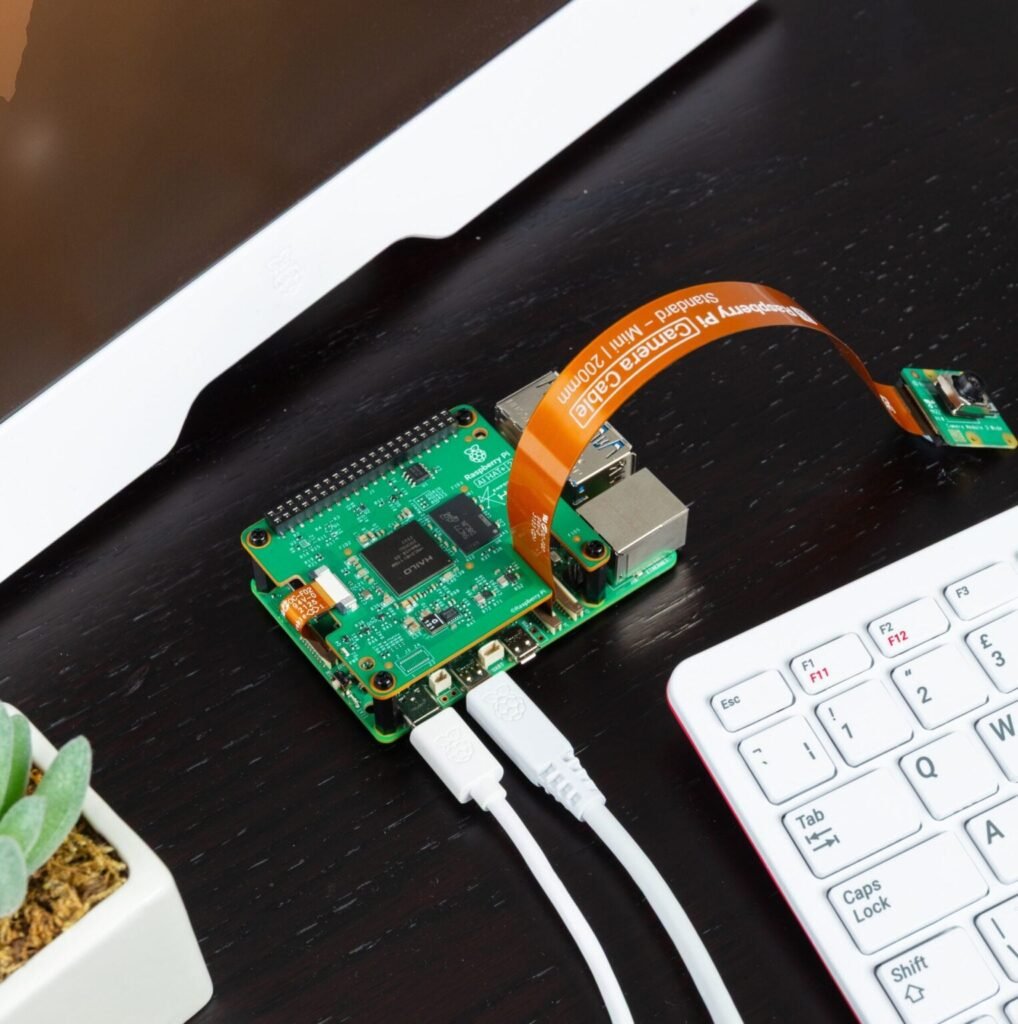
For vision-based models — such as Yolo-based object recognition, pose estimation, and scene segmentation — the AI HAT+ 2’s computer vision performance is broadly equivalent to that of its 26-TOPS predecessor, thanks to the on-board RAM. It also benefits from the same tight integration with our camera software stack (libcamera, rpicam-apps, and Picamera2) as the original AI HAT+. For users already working with the AI HAT+ software, transitioning to the AI HAT+ 2 is mostly seamless and transparent.
By far the most popular examples of generative AI models are LLMs like ChatGPT and Claude, text-to-image/video models like Stable Diffusion and DALL-E, and, more recently, VLMs that combine the capabilities of vision models and LLMs. Although the examples above showcase the capabilities of the available AI models, one must keep their limitations in mind: cloud-based LLMs from OpenAI, Meta, and Anthropic range from 500 billion to 2 trillion parameters; the edge-based LLMs running on the Raspberry Pi AI HAT+ 2, which are sized to fit into the available on-board RAM, typically run at 1–7 billion parameters. Smaller LLMs like these are not designed to match the knowledge set available to the larger models, but rather to operate within a constrained dataset.
This limitation can be overcome by fine-tuning the AI models for your specific use case. On the original Raspberry Pi AI HAT+, visual models (such as Yolo) can be retrained using image datasets suited to the HAT’s intended application — this is also the case for the Raspberry Pi AI HAT+ 2, and can be done using the Hailo Dataflow Compiler.
Similarly, the AI HAT+ 2 supports Low-Rank Adaptation (LoRA)–based fine-tuning of the language models, enabling efficient, task-specific customisation of pre-trained LLMs while keeping most of the base model parameters frozen. Users can compile adapters for their particular tasks using the Hailo Dataflow Compiler and run the adapted models on the Raspberry Pi AI HAT+ 2.
You can watch videos of LLMs and VLM operating on Raspberry Pi 5 on their YouTube channel. This module is already on sale, but it’s still expensive.