This post outlines the technologies employed in the vacuum cleaner robot, which enables it to clean the ground and navigate autonomously.
Motors and the cleaning process
The vacuum cleaner robot has side brushes that lead the dirt to the center, where a central brush lifts the dirt, to be sucked and stored in a deposit.
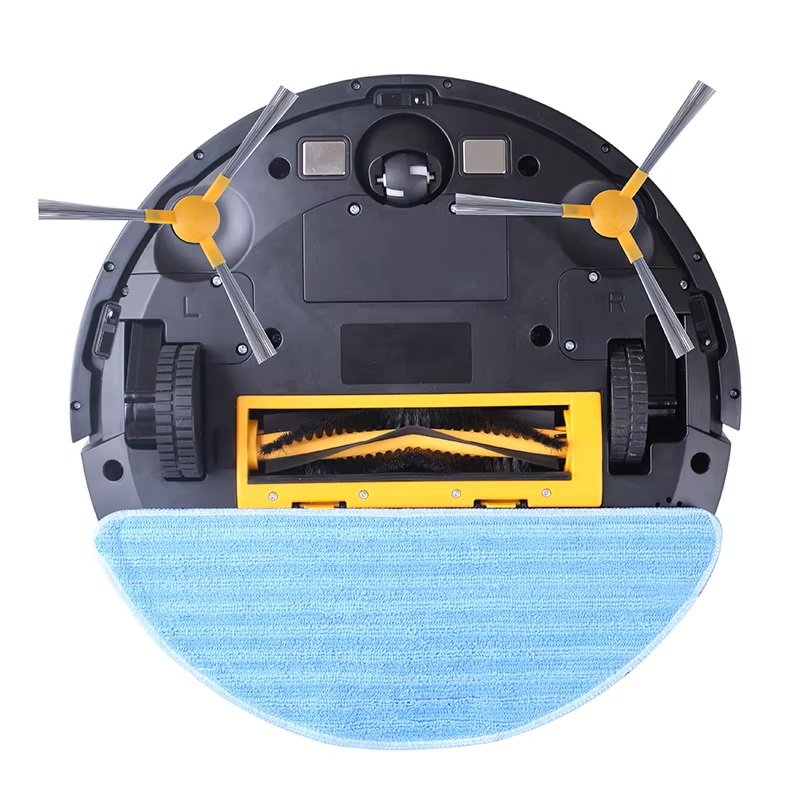
The blue part in the image above is a mopping cloth, soaked with a water reservoir inside the vacuum cleaner robot. To carry dirt to the deposit, the robot has a suction motor, whose power is measured in Pa (pascal). This motor creates an air pressure difference to vacuum up dirt.
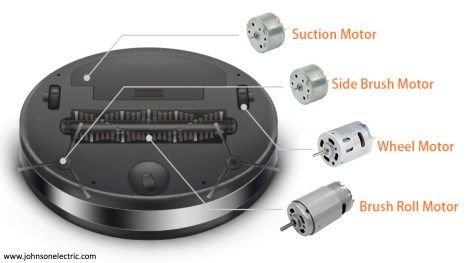
These motors can be brushed direct current (DC) or BLDC (brushless DC motor), depending on the model. Although brushed DC motors are cheaper, BLDCs are more efficient, durable, and generate less noise, because they don’t have brushes.
Autonomous navigation
Sensors are essential for the robot to detect objects to be avoided and cliffs, to avoid falls. The main sensors are:
- The bumper is the semicircular part on the front that collides with objects. When it touches an object, it activates a mechanical switch or infrared sensor, which sends electric signals to the controller.
- The wall sensor is another infrared sensor; there is one on each robot’s side. They serve to move close to the walls.
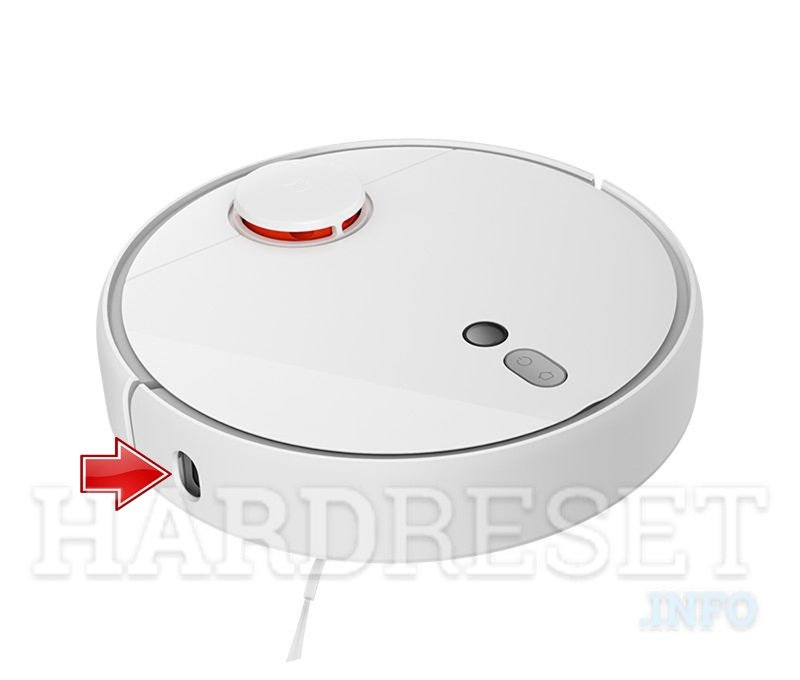
- To avoid falls, cliff infrared sensors are on the bottom part.
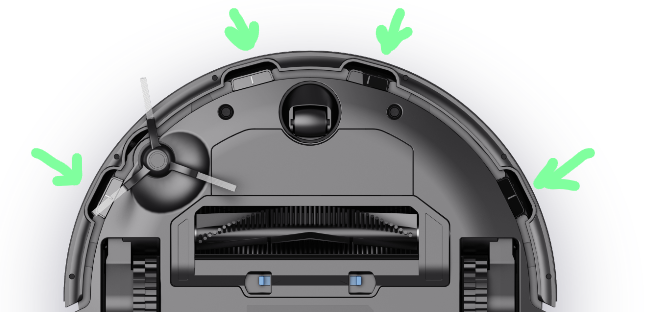
- Encoder: It’s connected to the wheels and measures the distance traveled.
If the robot navigates randomly through the environment, much time and energy will be wasted. Therefore, an algorithm and sensors are necessary for the robot to choose the most efficient trajectory to do the cleaning.
- A gyroscope is needed to measure orientation and direction, for efficient navigation and to turn on the right angles during the cleaning.
- LiDAR or LDS sensor, for environment mapping and the algorithm determines the best trajectory.
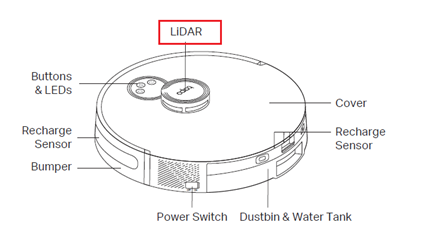
- Instead of LiDAR, some models use VSLAM (Visual Simultaneous Location And Mapping), a camera to recognize objects and do environment mapping.
Batteries and recharging of the robot vacuum cleaner
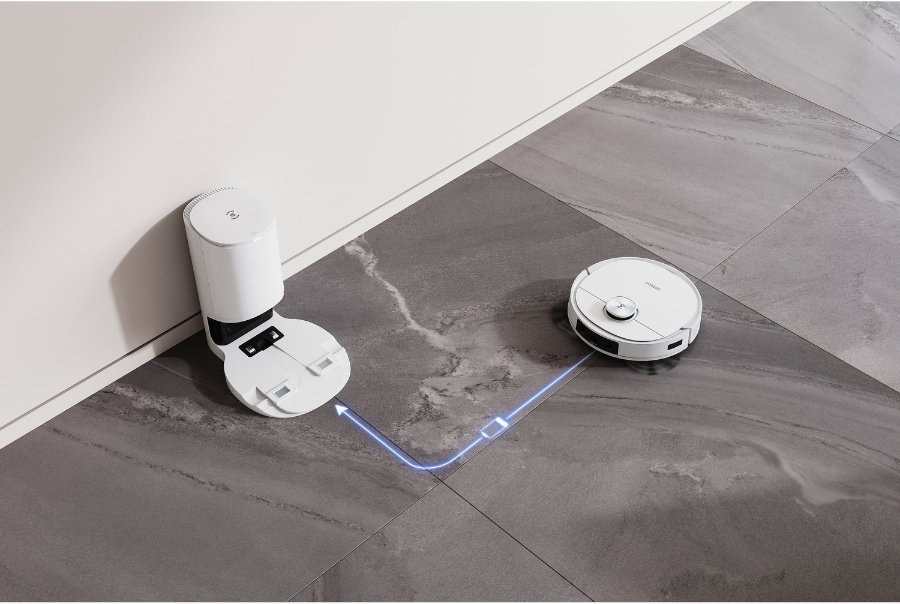
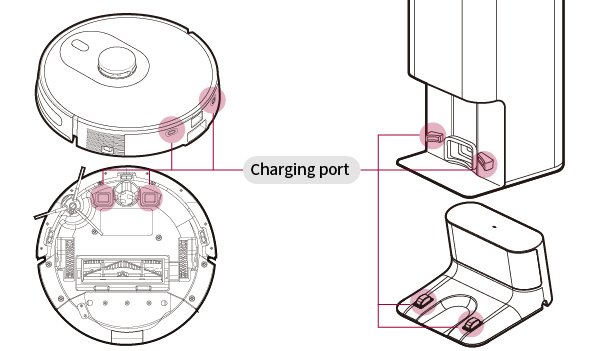
Most of the robots use lithium-ion or nickel-metal hydride (NiMH). If the battery becomes low, the robot returns automatically to recharging station.
Communication with the vacuum cleaner robot
The owner can communicate with the robot through Wi-Fi using an app on a cellphone. Can give instructions such as: designate forbidden areas in the environment where the robot won’t go, determine schedules for cleaning and select the rooms the robot must clean.