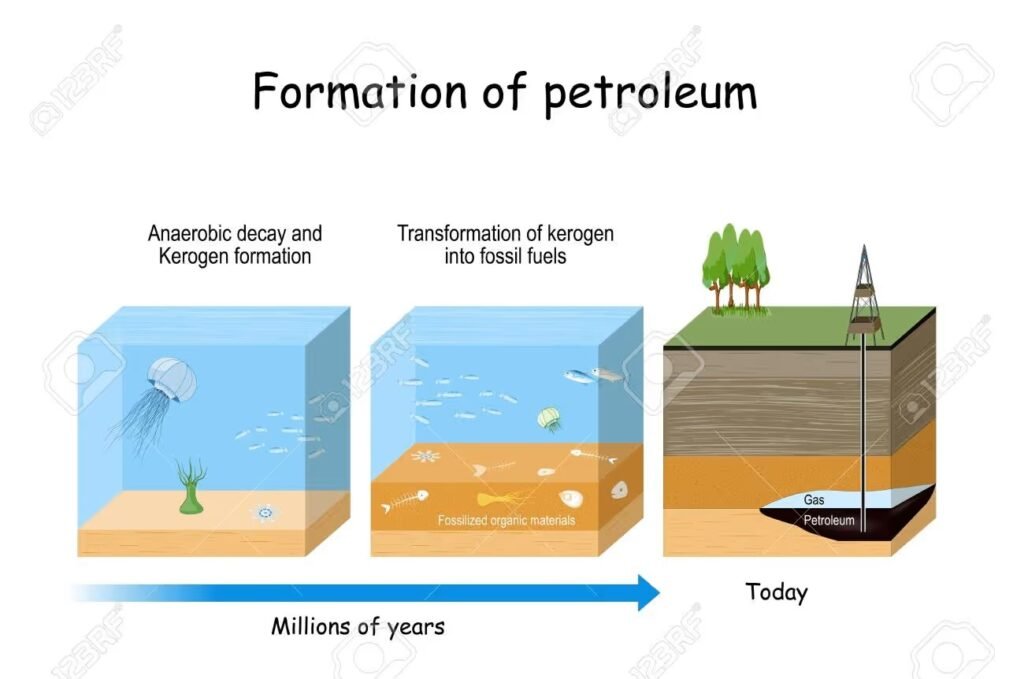
This post shows the origin of petroleum and its chemical, physical and biological processes that form this resource in our planet.
Formation process stages of petroleum and gas
All these stages take millions of years.
Diagenesis
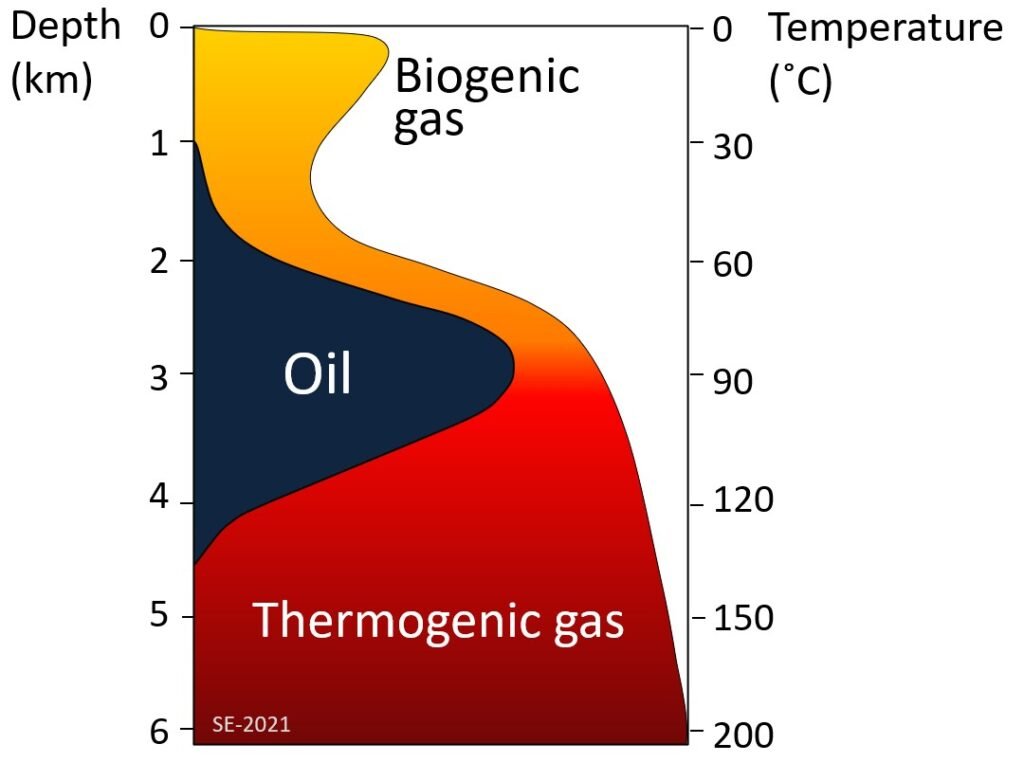
The organic matter, which are remains of animals, plants and other living beings, was deposited at the bottom of sea and lakes, subsoil or sedimental basin and borrowed by layers of sand, clay and rock fragments. In an environment with low oxygen level, depth around 1km (0.62 miles) and temperature at 50ºC (122ºF), the organic matter, mixed with sediments, becomes kerogen.
Initially, aerobic and anaerobic bacteria decompose organic matter’s polymers and produce water, carbon dioxide (CO_{2}), methane (CH_{4}) and smaller organic molecules, these are the biopolymers. While sediments are accumulated over time.
Kerogen
It’s a solid and insoluble organic material, without a defined chemical formula.
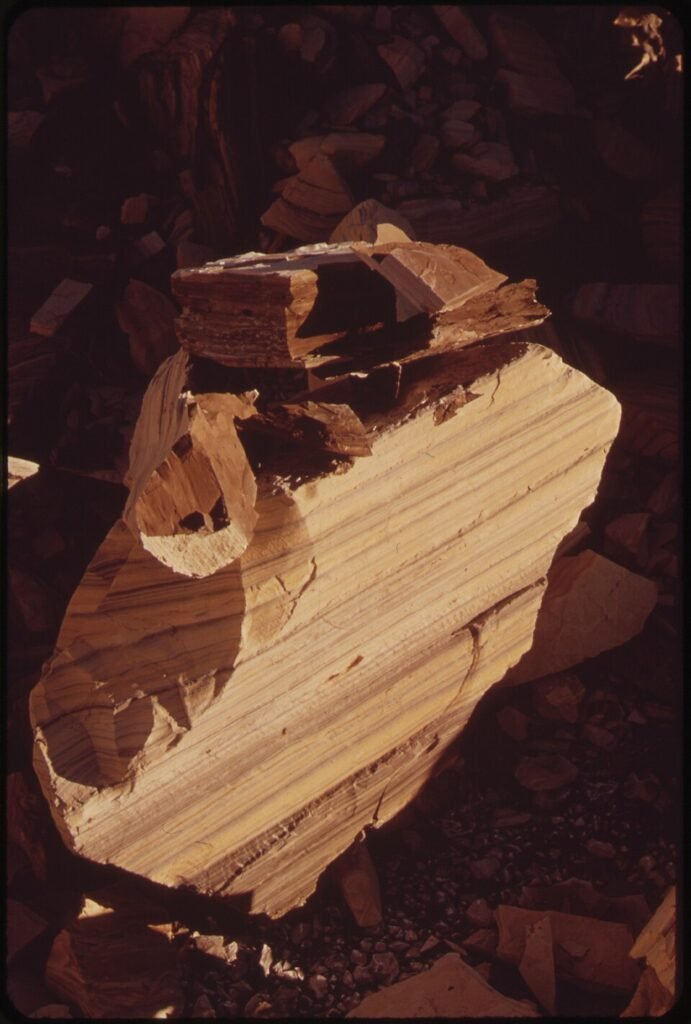
Kerogen classification
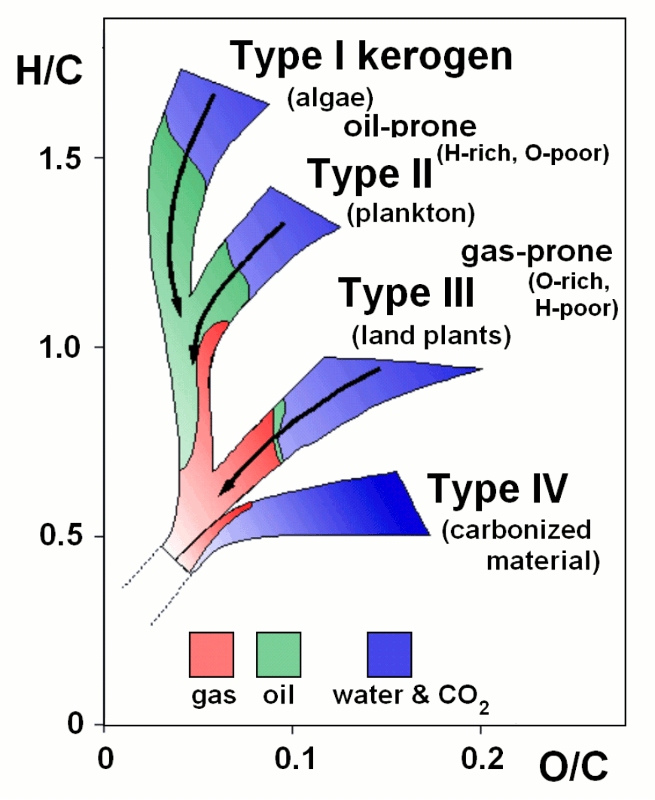
- Type I: Organic matter came mainly from algae and usually it’s found on rocks inside lakes. High hydrogen concentration makes it the best for producing liquid and gas hydrocarbons (HC).
- Type II: It’s found on seas and organic matter is derived from planktons and plants. It has less hydrogen and more oxygen than type I. However, still serves to produce HC.
- Type III: Organic matter originated from land plants. It has even less H/C (hydrogen/carbon) proportion and more O/C (oxygen/carbon) than the previous types. Therefore, it has potential for natural gas production.
Also exists the type IV, but the hydrogen quantity is so low that it doesn’t serve to produce hydrocarbons.
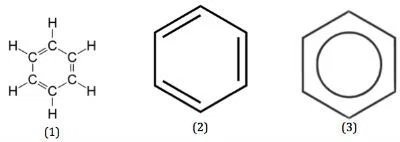
The type I has the less quantity of aromatic rings, while the type IV has the highest quantity.
Kerogen also can be classified by color. The best kerogen for oil production must have the colors light orange, dark orange or light brown. For gas production, dark brown color is the most suitable. While black kerogen don’t have application for HC production.
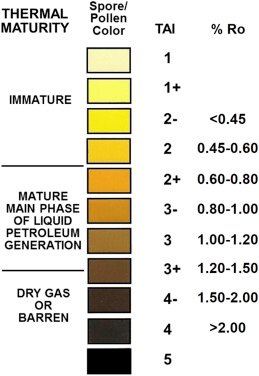
TAI is thermal alteration index, indicates the heat effect on mineral’s color and it’s maturity to produce petroleum and gas. While %Ro is the vitrinite reflectance, which measures thermal maturity based on reflection of a monochromatic green light.
Catagenesis
This is the stage where kerogen becomes petroleum. At temperatures between 60ºC (140ºF) and 150ºC (302ºF) and a depth between 1.5km (0.93 miles) and 4km (2.48 miles), kerogen molecules are broken, forming petroleum.
Metagenesis and metamorphism
On metagenesis, depth approximately between 4km and 5km (3.1 miles), petroleum molecules are broken, forming natural gas. Increasing even more temperature and depth, organic matter becomes carbon dioxide and remains of methane or dry gas. Metamorphism is the final stage.
Origin of organic matter that becomes petroleum
Less than 0.1% of organic matter becomes petroleum, most part is consumed by bacteria, fungi and other aerobic organisms, which break organic compounds in water, carbon dioxide, phosphates, sulphates and nitrates, to serve as nutrients for plants on soil. Most of petroleum came from planktons.
Most of current petroleum reserves were formed on Mesozoic Era (between 252 and 66 millions of years ago).