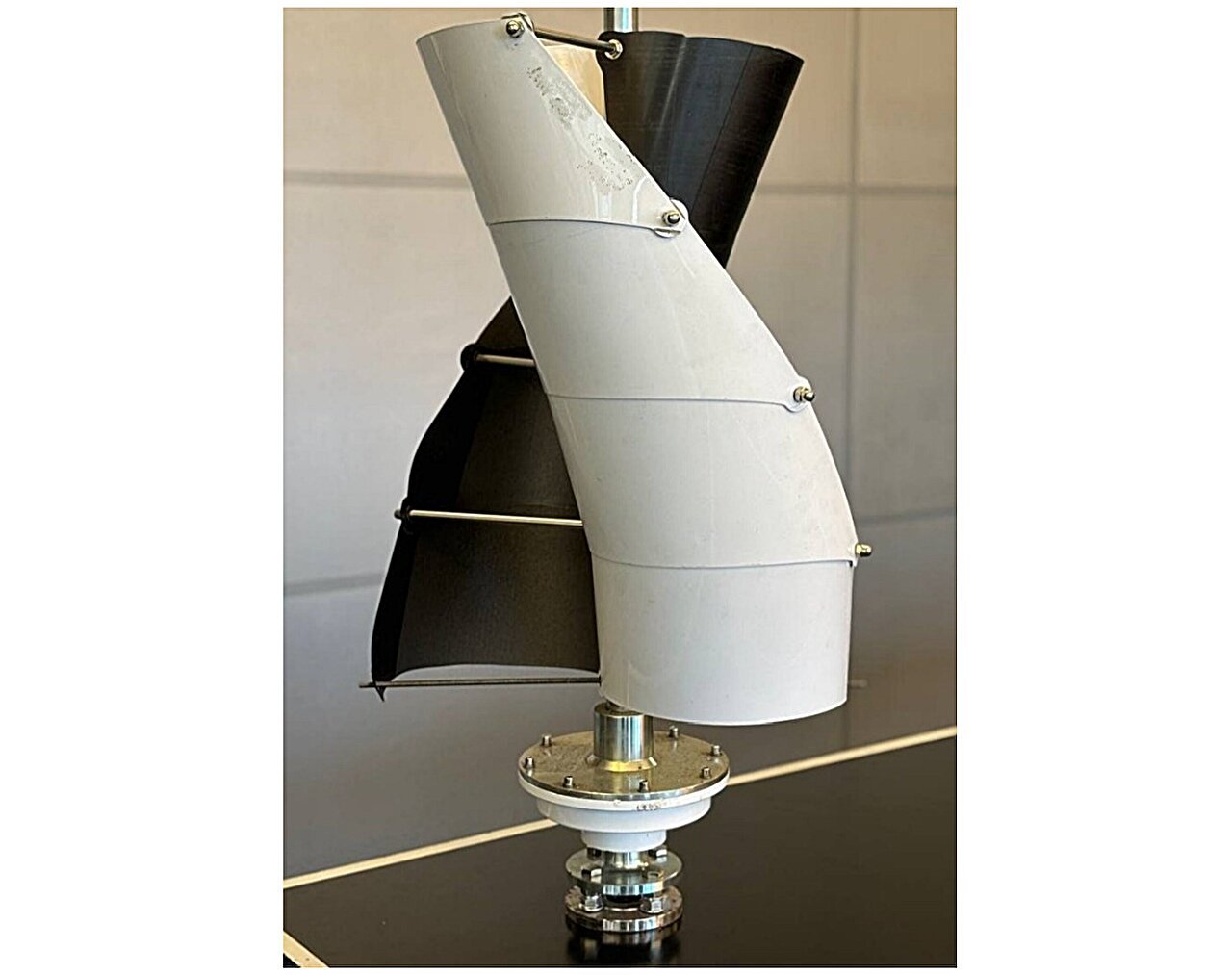
A wind turbine was built using a technique called 4D printing.
To know how a wind turbine works, click on the link below.
Operation of a wind turbineClick here
Source: TechXplore
A new manufacturing technique developed by Concordia researchers could make small wind turbines lighter, less expensive and easier to produce. Using a process known as 4D printing of composites, Ph.D. candidate Emad Fakhimi and Suong Van Hoa, a professor at the Concordia Center for Composites, created curved blades for vertical-axis wind turbines from flat carbon-fiber composite panels. The study is published in the journal Polymer Composites.
Vertical-axis wind turbines are increasingly used on buildings and in urban settings, but their curved blades are typically made using specialized forming processes that require complex molds. These molds add cost, manufacturing time and weight to the final product.
To address this problem, the researchers developed a new, first-of-its-kind “inverse” design procedure. Rather than starting with a particular layup—the arrangement and orientation of carbon-fiber layers—and observing the resulting shape, they began with the desired blade geometry and worked backward to determine how the layers should be arranged and oriented to produce it.
During manufacturing, flat carbon or epoxy laminates are cured and then naturally deform into curved shapes as they cool, thanks to carefully engineered differences in material properties across the layers.
The resulting blades closely matched the shape of commercial aluminum turbine blades while weighing 80% less. In laboratory tests, turbines fitted with the composite blades rotated faster than those equipped with aluminum blades. The approach could reduce manufacturing costs and expand the use of lightweight composite structures in renewable energy systems and other engineering applications.
Layup is the process of stacking material layers and curing is the process to make materials to adquire desired properties.