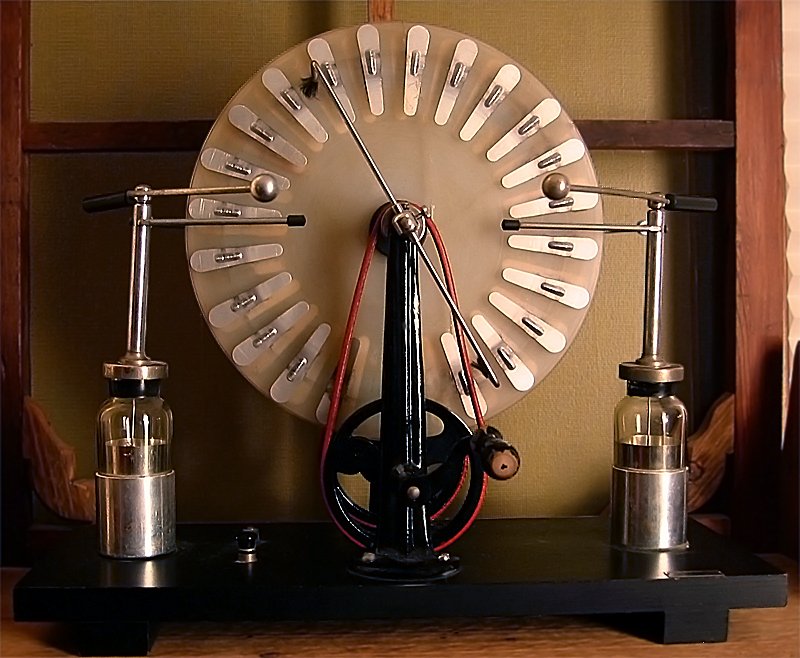
The Wimshurst generator produces high voltage static electricity with the movement of a crank. This post explains how it’s possible.
Wimshurst generator operation
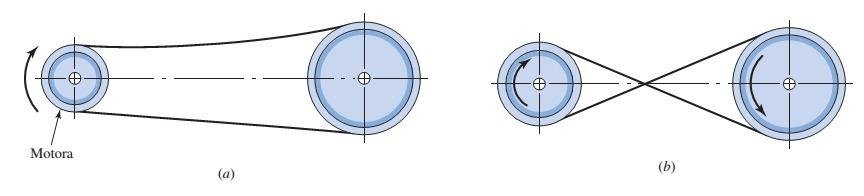
It was invented by the British engineer James Wimshurst in 1883, after three years of development. It has two disks with the same diameter and thickness, they spin in opposite directions on the same axle. The crank spins the base pulleys, which move they respective belts and pulleys with smaller diameter linked to the disks by an axle.
Disks are made of insulating materials such as plastic, glass or acrylic and they have metal plates called sectors.
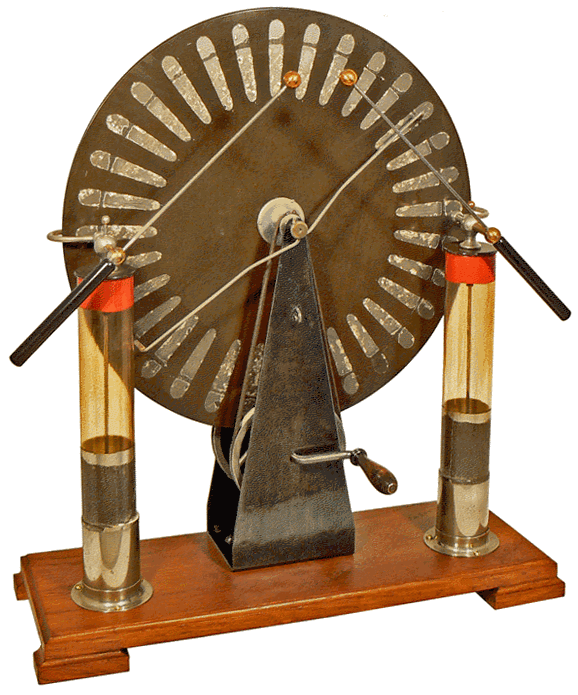
To start working, one of the metallic plates must have a small quantity of negative charge (excess of electrons) or positive charge (lack of electrons). To obtain this, it’s important that the air isn’t too humid. The electrically charged metal plate, or inductor, attracts opposite sign charges from plates on the other disk (induced) and repel charge with the same signal. This is the electrostatic induction.
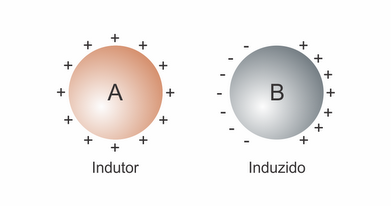
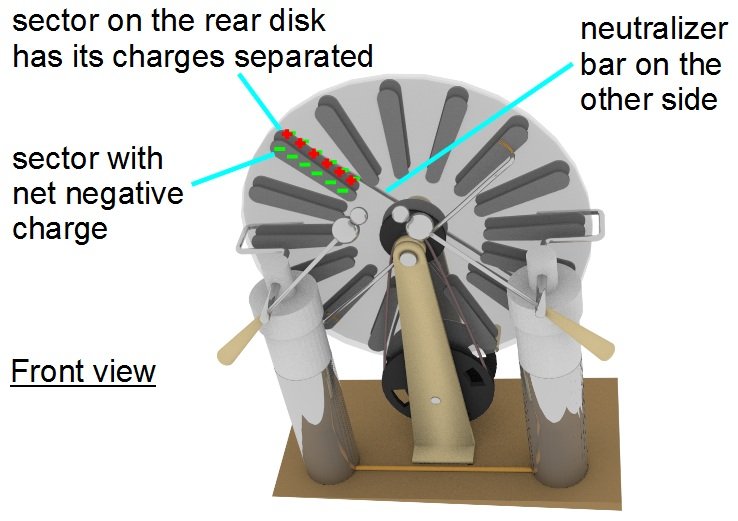
While the disks spin, more sectors are induced.
Neutralizers
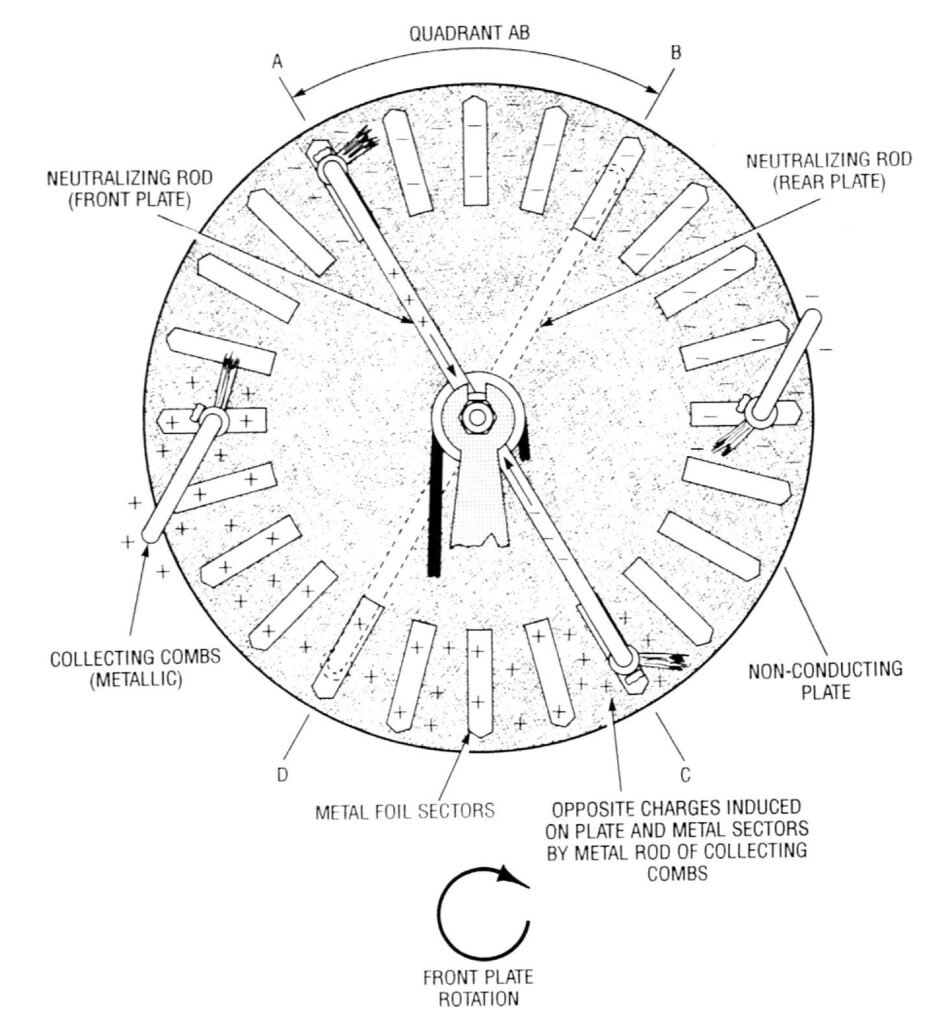
They are two bars with conductive brushes, they transfer electric charge from a plate to another on the same disk, it become charged while the former changes signal. For example, if a sector initially with negative charge electrically induces another sector, it passes through the neutralizer, which transfers negative charges to the plate on the opposite side. Consequently, the originally induced plate becomes positively charged.
Collectors
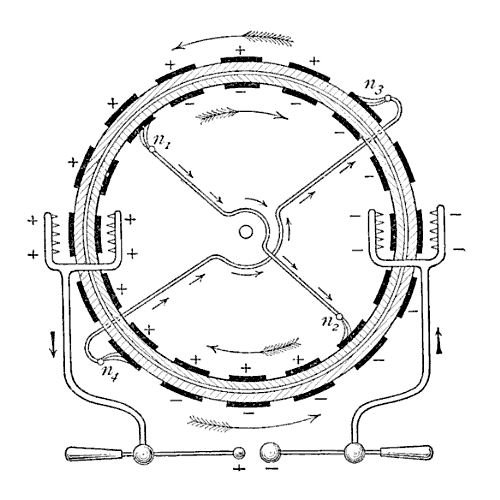
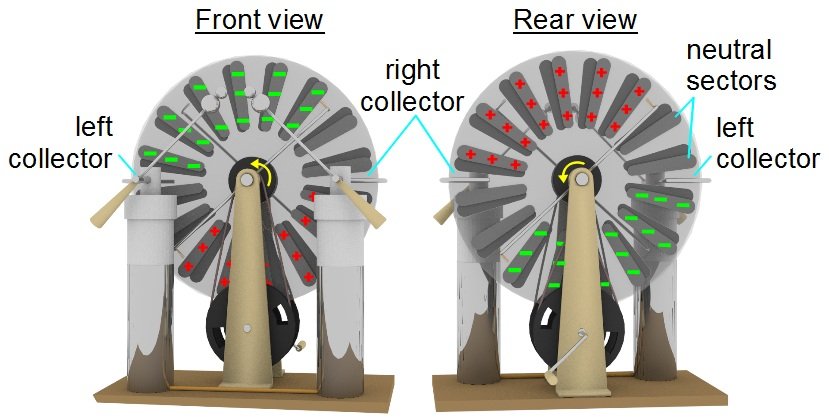
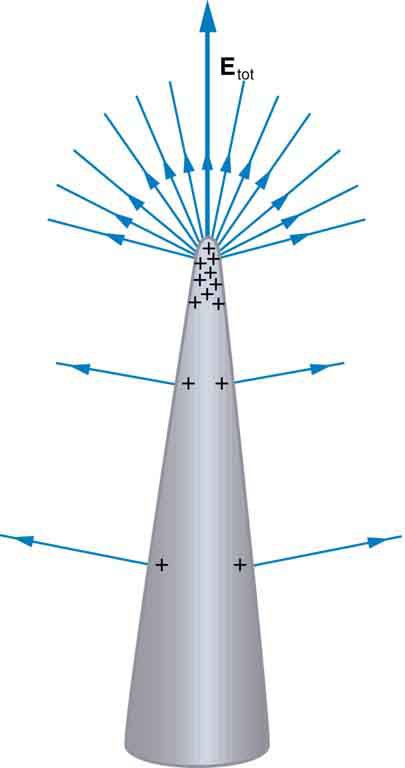
Conductors in ‘U’ shape with ‘combs’, which collect electric charges, making the sectors electrically neutral and they don’t touch the disks, one collector absorbs positive charges and another absorbs negative charges. Why collectors must have thin combs? Charges accumulate on tips due to smaller surface, creating a stronger electric field. Therefore, charges with opposite signs receive a higher electric force. This is the electrostatic tip effect.
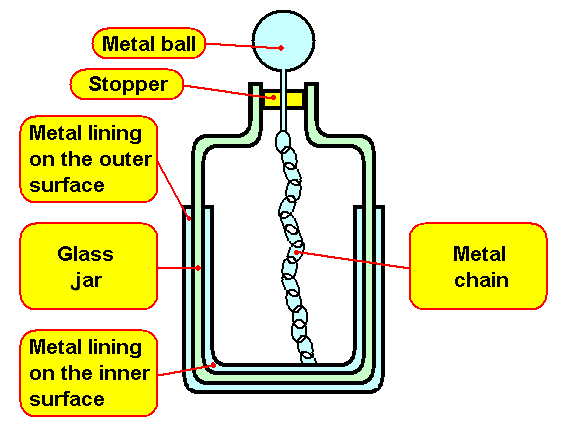
Leyden jar
It’s a capacitor, as such, store electric charges. Consists in a jar made of dielectric material, such as glass, whose inner and outer walls have conductive layers. Receives charge due to a conductor ball linked to a conductor in contact with the inner wall, the outer wall must be grounded so that it can be charged with opposite sign of the inner wall.
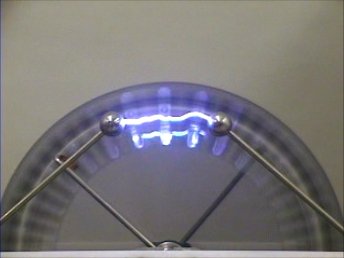
Finally, the large potential difference between the conductive spheres creates electric arcs.
Applications in the past and present
At the early 20th century, due to its capacity to produce high voltages, the Wimshurst machine were used to obtain X-ray images and to make experiments such as the Crookes tube. Currently, the generator is present in schools, universities, museums to teach electrostatics.
A Wimshurst generator video
This Wimshurst machine is from the Hungarian Electrotechnical Museum.