This article about rainforest burning was written by Antonio Ademir Stroski, Agricultural Engineer and Master in Environment.
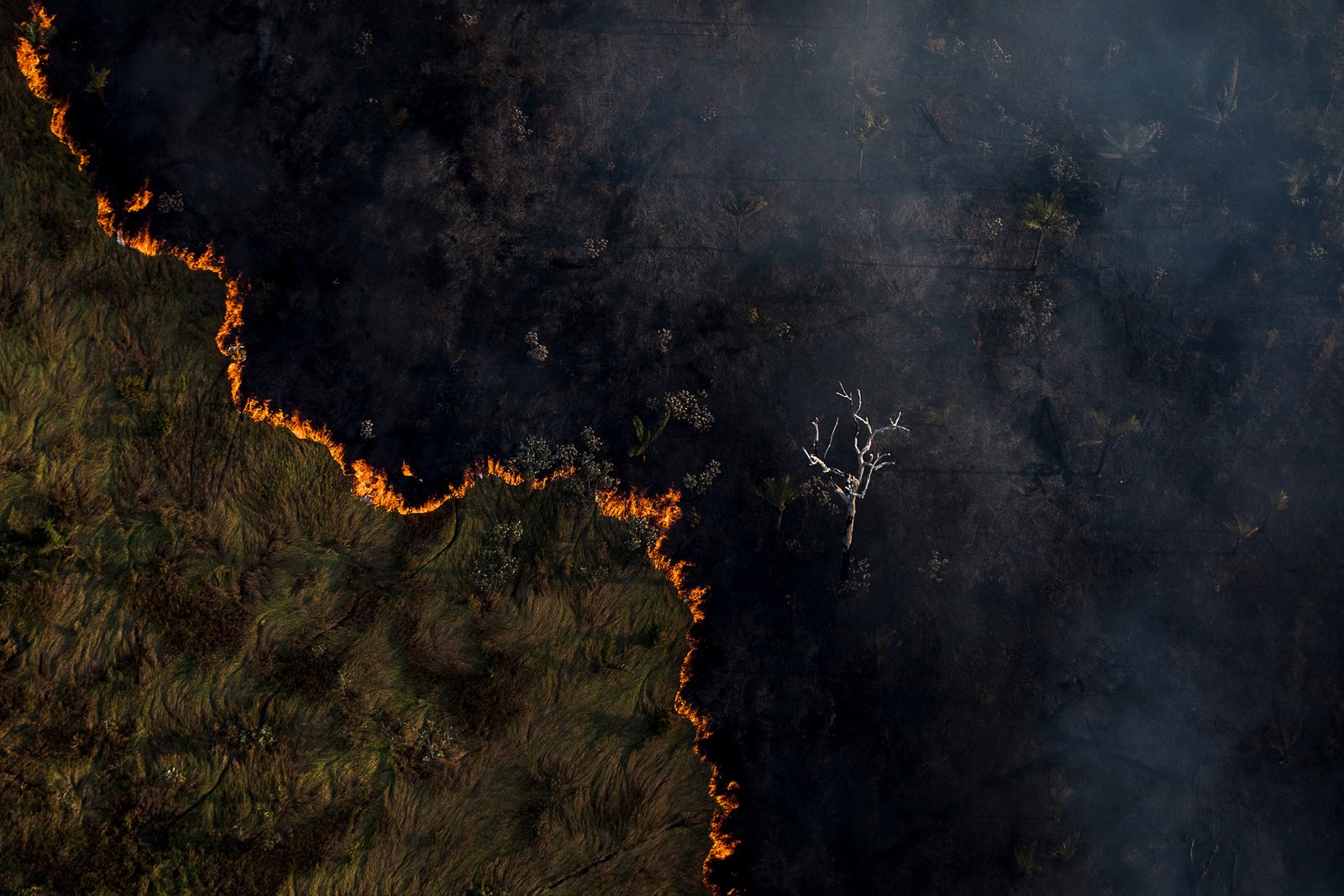
Living for 48 years on Amazonas state, Brazil, I state that never before the smoke for forest burning were so intense, for many days, in this state’s urban and rural environment, as right now in 2026, with disturbances, damages and compromised air quality, reaching particle levels never seen before. This scenario on time is marked by absence of rains, higher average temperatures, small wind circulation and components increased by severity conditions due to the climatic phenomena El Niño.
Among the causes which originate so much smoke, remain between the family-based agriculture, the regular use of fire as a method to prepare the soil, focusing on the cultivation of annual crops, especially cassava destinated to flour production, an indelible cultural identity within the local diet.
Through the years, despite the initiatives which seek to prevent the irregular occupation of public lands, non-destinated lands or territories which belong to conservation units, with this nefarious process to the environment, sustainable production and social harmonic relations in rural areas, occurs the non-authorized removal of vegetation which covers the soil, partially or by clear-cutting and complete, before summer, for the following stage, making slash and burn, notably between July and October, an instrument of illegal appropriation of large areas, causing great disturbance and environment damage to people and animals who live on the biggest rainforest of the planet ou live in the Amazonian cities, making one of Brazil’s main contributions for emission of greenhouse gases.
With consolidated occupation and absence of oversight and environmental control, they start to implement activities that weren’t planned in accordance with land use and suitability, climate and recommended techniques. Predominating beef cattle farming, whose pasture is getting poorer through the years, exposing one of the highlighted features of this activity on the region: low productivity per hectare. However, due to soy commodity on world market, in recent years, this alternative use of soil is being replaced by the new agrarian activity, which grows significantly on Brazilian Amazon. But, unfortunately, some of these areas, after the drastic change on vegetation and the provoked environmental damages, are abandoned, remaining as an active to be negotiated: illegal land trade.
In recent days, a concerning finding about the profile of rural properties related to this issue. In Amazon state, a total of 1,639 heat points, detected by the National Institute of Space Research (INPE), in October’s first half, 80% were on private properties with a Rural Environmental (CAR) and appeared on 4th of this month, but none of the properties had authorization from environmental state institution to use fire, therefore, they were criminals.
The challenge is to implement public policies to fight illegal deforestation and forest burning, encompassing, in addition to an efficient monitoring system, measures to incentivize sustainable economic development, with low carbon emission, reaching all social strata that inhabit the biome.