HiLumi LHC is an improvement program for the LHC, to increase luminosity, by that, the number of collisions.
Posts about CERN, where LHC is located.
Electrical e-Library at CERN (Part 1)Click here
Electrical e-Library at CERN (Part 2)Click here
Source: Innovation News Network
Teams have been dismantling sections of the 27-kilometre machine since 7 September, preparing to remove 28 superconducting magnets.
The first magnet interconnection was cut this week at LHC Point 1, where the ATLAS experiment is located, marking the start of this stage of work during the LHC’s third long shutdown, LS3.
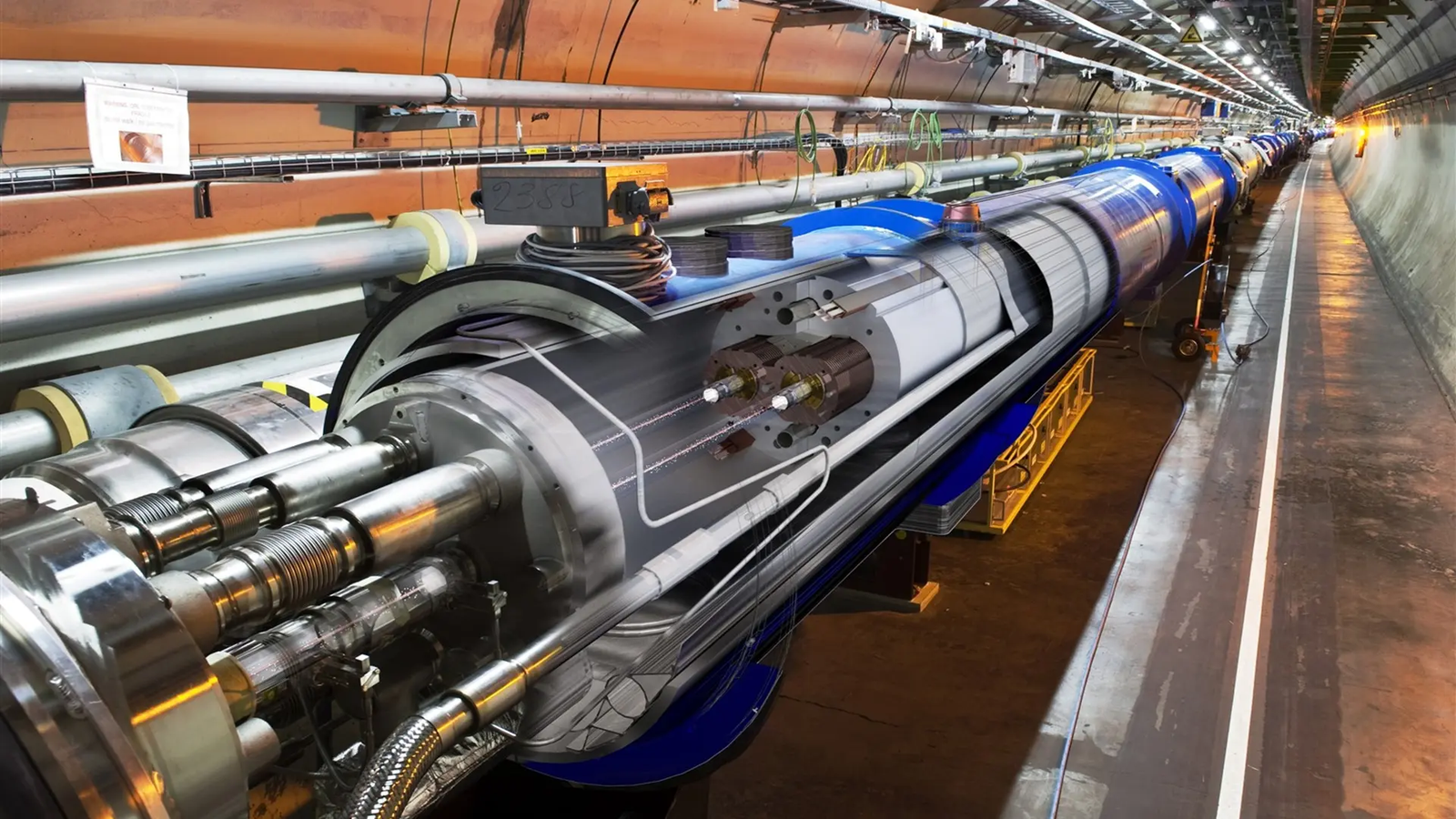
At the centre of the operation are new inner triplets, which focus the particle beams immediately before they reach the experiments.
The replacement magnets use niobium-tin superconducting coils and can produce magnetic fields of 11.3 tesla, around 40% stronger than those generated by the existing magnets.
Markus Zerlauth, the HiLumi LHC Project Leader, said: “The current inner triplets date back to the LHC construction phase and were installed in the machine between 2005 and 2007.”
The LHC relies on thousands of magnets to control and manipulate its particle beams.
The inner triplets are particularly important because they consist of three quadrupoles positioned on either side of the experiments and tightly focus the beams before collisions take place.
This focusing compresses the beams, increasing the likelihood of particles colliding. That directly contributes to the collider’s luminosity, which measures the number of collisions occurring over a given period. Higher luminosity lets experiments collect more data.
The new magnets are therefore a key component of the HiLumi LHC, which is being developed to increase the LHC’s collision rate and data output substantially.
The replacement inner triplets result from years of research and development and represent a significant technological change from the current niobium-titanium magnets.
The new niobium-tin technology will be installed around ATLAS and CMS, where the increased luminosity is required.
ALICE and LHCb have different physics programmes and operating requirements, so they will retain their existing inner triplets, although these will be improved to allow both experiments to benefit from the luminosity increase.
Jean-Philippe Tock, Head of the LS3 Coordination Team, added: “The first quadrupole of the new triplets should arrive in the tunnel at the start of 2029. In total, 16 cryostats and 28 cryo-assemblies will be installed – a major undertaking.”
According to the HiLumi LHC’s website, the collider with improvements will be turned on again in mid-2030.