


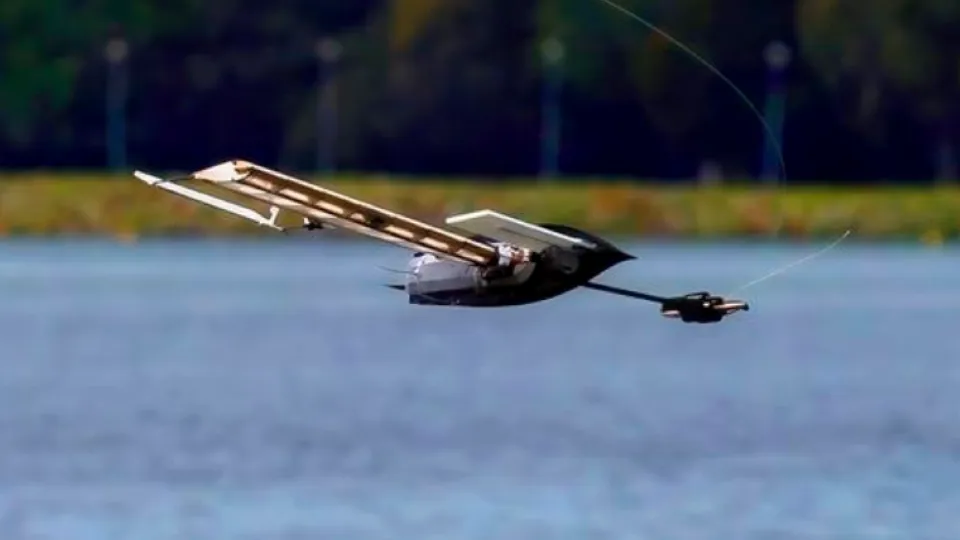
ALBATROSS is a robotic platform for environmental monitoring, developed by Singapore University of Technology and Design (SUTD).
Source: The Engineer
The system, called ALBATROSS (Airborne Lander with Buoyant AuToROtating Sailing Sensor), is designed to combine rapid aerial deployment with the ability to remain on the water for extended periods. The researchers envisage future versions monitoring environmental conditions in remote locations for weeks at a time. The platform is detailed in Science Robotics.
“Surface systems are useful because they can remain at sea, but they are constrained by how long it takes to get to the target location,” said Professor Foong Shaohui, Associate Head of the Engineering Product Development Pillar at SUTD.
“With ALBATROSS, we wanted to use the best of both worlds: the speed of aerial deployment to reach remote waters quickly, and the endurance of sailing to remain there for long-duration monitoring.”
ALBATROSS uses rigid wingsails to control its descent before providing propulsion once the platform reaches the water. During its fall, the wings rotate passively in a motion similar to that of a falling maple seed, reducing descent speed and helping to stabilise the vehicle. After landing, the wings act as sails, harnessing the wind to propel the platform.
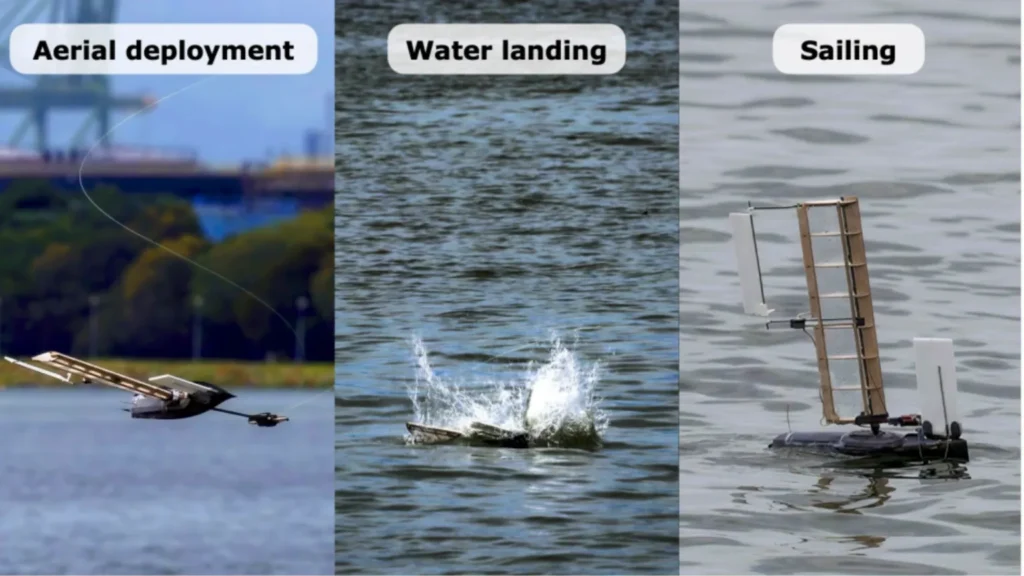
A rudder inspired by a fish’s tail provides steering, including when wind speeds are low. By using the same components for both aerial descent and surface propulsion, the design avoids the need for a separate parachute or dedicated landing mechanism.
The researchers said the system uses three actuators and three navigation sensors compared with six to eight actuators and more extensive sensor arrangements in other hybrid aerial and marine platforms.
During field trials, ALBATROSS was released from a height of 150m. It descended while rotating, landed on the water with limited impact, righted itself and began sailing without human intervention. The team estimates that a comparable platform without autorotation would experience approximately 18.5 times more impact energy on contact with the water.
In trials conducted in Singapore reservoirs, a larger test version navigated autonomously between predetermined waypoints, reaching a peak sailing speed of just under 1km/h. It operated for around three hours while collecting environmental data, including humidity, heat levels and wind direction.
Potential applications include environmental monitoring, climate research, search and rescue, and maritime security. Its combination of aerial delivery and wind-powered movement could allow sensors to reach otherwise difficult-to-access locations without relying on continuous powered propulsion.
However, ALBATROSS remains a proof-of-concept, and testing has so far taken place in sheltered reservoir environments rather than exposed seas. Further development will be needed to establish how the platform performs in stronger winds, currents and waves.
Future iterations could incorporate additional monitoring equipment, including underwater sensors and sonar, alongside larger energy-storage systems.
The video below shows ALBATROSS being deployed by a drone.
.)