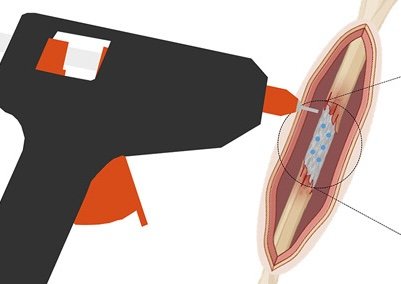
Scientists modified a glue gun to 3D print a material that can repair fractures in bones.
Post about 3D printingClick here
Source: LiveScience
The device, which has so far been tested in rabbits, would be particularly useful for fixing irregularly shaped fractures during surgery, the researchers say.
“To my knowledge, there are virtually no previous examples of applying the technology directly as a bone substitute,” study co-author Jung Seung Lee, a biomedical engineer at Sungkyunkwan University in South Korea, told Live Science in an email. “This makes the approach quite unique and sets it apart from conventional methods.”
Typically, large fractures or other defects in bones require bone grafting and the use of a metal fastener, such as a pin or plate, to support the broken bone as it heals. But because the shape of these implants is not specific to a given patient’s fracture, this can result in poor alignment and compromised stability of the bone.
Previous studies have shown that 3D printing bespoke bone grafts for individual patients can be done, but these required considerable time and effort to make, preventing them from being used on the fly during surgery.
Now, in a study published Friday (Sept. 5) in the journal Device, Lee and colleagues detailed their new method of 3D printing a bone substitute directly onto a fracture using a glue gun. In the research, they successfully tested the technology on rabbits with leg fractures.
Basic 3D printing commonly uses a flexible, plastic thread, which is heated and then formed into the desired shape. But Lee and colleagues created a filament composed of two materials: polycaprolactone (PCL), which has been used in previous studies to create biodegradable bone scaffolds, and hydroxyapatite (HA), a mineral form of calcium important for bone structure. They also incorporated two antibiotics into the filament to help prevent infection; these drugs diffuse slowly out of the filament over several weeks.

Using a glue gun modified to extrude the calcium-based filament at a low temperature, the researchers created small shapes that cooled to body temperature within 40 seconds. They were then able to print 3D bone grafts directly onto fractures and defects during surgeries on the lab rabbits.
The researchers tested their 3D-printed bone grafts on New Zealand white rabbits (Oryctolagus cuniculus). They braced the fractures with metal plates and screws, and then filled the rabbits’ bone defects with either their special bone-like filament or with traditional bone cement and followed the rabbits’ progress over 12 weeks.
The rabbits with the new fracture treatment had better outcomes, including better bone tissue formation and denser bone growth over the three months, compared to the rabbits given traditional treatment. By the end of the study period, the experimental bone material had degraded by about 10%, they noted.